Mo Beiyu Hides and Cares for Su Xiangwan
CEO's Beloved Honey GirlMo Beiyu Hides and Cares for Su Xiangwan is the episode in which Mo Beiyu shelters Su Xiangwan after finding her unconscious and assumes responsibility for her immediate survival. He provides water, warmth, secrecy, and practical care while she is too weak to stand, yet the refuge quickly becomes dangerous when Lu Xun traces her location and arrives with police and bodyguards. The episode therefore does more than record an act of rescue: it places two competing forms of protection against each other, one organized around quiet medical care and the other around marital authority, pursuit, and possession.
Collapse and Discovery
Su Xiangwan is found after she has already fainted by the roadside. When she wakes, she is in a small bedroom that resembles an ordinary commercial apartment, with no distinctive feature revealing where she has been taken. The unfamiliar room frightens her, and her first suspicion is that Mo Beichen has found her. Mo Beiyu corrects the mistake by identifying himself and giving her warm water, establishing that the person who has taken her in is not the man she fears but a relative’s doctor-like protector.
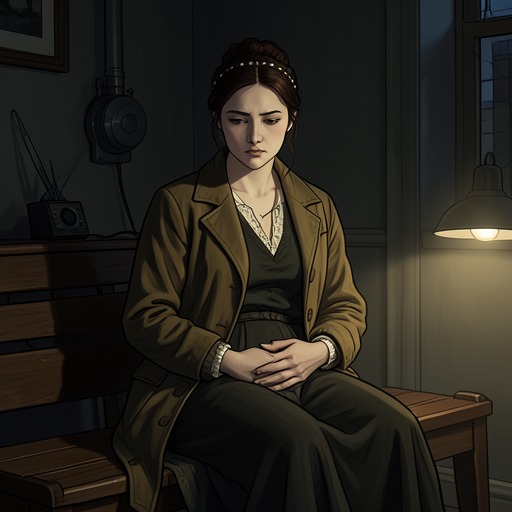
Her physical condition makes the intervention urgent rather than ceremonial. She tries to sit up but discovers that her body has no strength, and she can only abandon the attempt. Mo Beiyu supports her against him and feeds her water directly. When she spills it over him and, embarrassed, says that she will not drink, he reminds her that she has been feverish for two days and insists that she must take fluids. His care is therefore expressed through small, repeated acts—lifting her, bringing the cup to her lips, helping her lie down, and covering her with a blanket—rather than through a single declaration of concern.
A Refuge Built Through Care and Secrecy
Mo Beiyu explains that his cousin discovered Su Xiangwan during her morning practice. Su Xiangwan was already unconscious, and the cousin brought her home, changed her clothes, and cared for her for two days. Mo Beiyu happened to be living at the same house, which places him in the role of an available guardian rather than a planned rescuer. The arrangement gives Su Xiangwan a protected place to recover, but it also leaves her dependent on people who must decide how much of her presence to disclose.
Mo Beiyu does not want Mo Beichen to learn that Su Xiangwan is staying there. He has already been urged five times to leave, and he fears that any further delay will arouse suspicion. To preserve the hiding place, he instructs Liu Xi to keep Su Xiangwan’s presence secret. At the same time, he knows that her condition will prevent her from recovering for roughly another week. His predicament is practical and ethical at once: remaining protects a sick woman, while remaining too long may expose both her location and the people sheltering her.
The concealment also reveals that care in this episode is collective. Mo Beiyu performs the visible bedside labor, but his cousin changes Su Xiangwan’s clothes and looks after her, while Liu Xi becomes responsible for maintaining the secret. The household temporarily functions as a protective network. Its members do not treat Su Xiangwan as a possession to be transferred; they treat her as an incapacitated person whose condition requires time, supervision, and discretion.
Lu Xun’s Search and the Collision of Claims
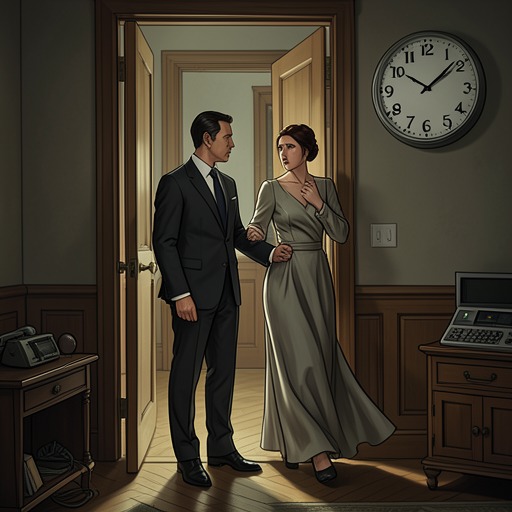
The refuge ends when surveillance leads Lu Xun to the apartment. Four or five police officers appear at the door, accompanied by a noble-looking man in a low hat and additional bodyguards. The police state that surveillance showed a young woman being rescued by the roadside two days earlier and ask whether she is inside. Their presence converts a private act of assistance into an official-looking retrieval operation.
Mo Beiyu refuses to surrender the apartment’s privacy without proof. He objects that the visitors have come abruptly and entered the matter without properly establishing their authority. Lu Xun then identifies himself as Su Xiangwan’s husband and says that he has come to take his wife home. The language of marriage is used as a claim of access, but Mo Beiyu challenges the assumption that a marital relationship automatically settles the woman’s wishes or the ethics of the situation.
Mo Beiyu’s argument has three parts. Lu Xun must first establish that Su Xiangwan is actually there; even if she is his wife, she still possesses her own freedom; and taking her away requires her consent. This position sharply contrasts with Lu Xun’s impatience. Lu Xun dismisses Mo Beiyu as an outsider and threatens to involve Han Dong, the golden-ranked lawyer of Cloud City and the Imperial Group’s exclusive legal adviser. Legal resources and police presence thus stand behind Lu Xun’s personal demand, while Mo Beiyu relies on the immediate moral fact that Su Xiangwan is ill and unable to advocate for herself.
The confrontation becomes openly accusatory when Mo Beiyu says that Lu Xun has tortured his woman until she fainted by the roadside and calls him a rapist and scum. The accusation identifies the central contradiction of Lu Xun’s position: he presents himself as the husband retrieving his wife, while Mo Beiyu sees the injured body as evidence that Lu Xun’s claim to intimacy has become an instrument of harm. Protection and control use the same vocabulary of concern, but the scene forces them into opposition.
The Failed Handover and Its Aftermath
Su Xiangwan eventually comes out under the attention of the assembled police and bodyguards. She is burning with fever, her legs are weak, and her consciousness is fading. At the elevator she reaches toward the button but loses consciousness before touching it, collapsing in front of the people who have come to take her away. Her body interrupts the dispute more decisively than any argument could. The question of who has the right to remove her is overtaken by the evidence that she cannot safely move under her own power.
Lu Xun’s response remains severe and possessive. He orders his bodyguards to contact Hua Shuo, tell him to wait at the Scenic Mountain villa, and threaten to raze Hua Shuo’s studio because Lu Xun will not be able to see him. The threat shows that the retrieval has not resolved the underlying conflict; it has widened Lu Xun’s anger toward anyone associated with Su Xiangwan’s care. The episode’s immediate consequence is not reconciliation but the restoration of Lu Xun’s physical access to a wife whose weakness has made her vulnerable to decisions made by others.
Later scenes preserve the unstable boundary between care and coercion. When Su Xiangwan emerges after crying, Lu Xun grabs her arm and offers to apply ointment Hua Shuo has provided. She says she will do it herself, but Lu Xun replies that the decision is not hers to make. The gesture resembles nursing, yet the refusal to accept her choice repeats the very problem Mo Beiyu identified: assistance can become another method of control when the recipient’s consent is treated as irrelevant.
Significance in the Relationship Pattern
Mo Beiyu’s intervention gives Su Xiangwan a rare interval in which survival depends on shelter rather than obedience. He feeds her because she is too weak to drink independently, explains the circumstances of her rescue before she can formulate all her questions, and hides her from Mo Beichen because he believes disclosure would endanger the refuge. His behavior is protective, but it is also constrained by secrecy, medical urgency, and the danger of Lu Xun’s pursuit.
The episode also places Mo Beiyu within a wider network of contested relationships. Chu Fei later describes Su Xiangwan as resembling a close relative while insisting that he has no blood tie to the woman he likes, and he distinguishes his pursuit from forced possession. Su Xiangwan herself, in a confused and flirtatious moment, identifies Lu Xun as her husband. Lu Xun likewise insists on marital status, while Shen Yiyun is described as an adopted cousin rather than a blood relative, a distinction that becomes part of the household’s argument about intimacy and boundaries. Against this recurring instability of kinship language, Mo Beiyu’s claim is comparatively plain: a woman who has been injured and found unconscious needs care, and even a husband cannot erase her freedom.
The action therefore functions as both rescue and test. It exposes Su Xiangwan’s vulnerability through fever, collapse, and dependence; it gives Mo Beiyu an ethical basis for opposing Lu Xun; and it reveals how quickly tenderness can be absorbed into possession. The hiding place lasts only until surveillance defeats secrecy, but the principle articulated there continues to trouble Lu Xun’s authority: marriage may name a relationship, yet it does not by itself transform another person into property.